Jun 8, 2010
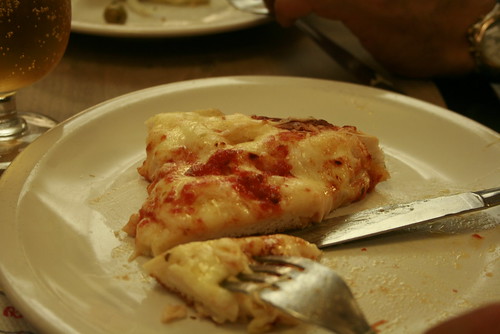
Pizza inflation in Buenos Aires
Tyler Cowen links us to this guy's blog, where he has been uploading pictures of Ugi's, a pizzeria in Buenos Aires, since 2000. He even collected the price data, and calls it Ugi's index. I played a bit with it and calculated the implied inflation rate and compared it to the official one. Of course, this homemade chart has to be taken with a grain of salt... but still, governments lie. What would I do for a muzza now...

Jun 7, 2010
The Euro/CHF fx and trade along the border in switzerland
Since the beginning of the Euro-turmoil the, Swiss National Bank has intervened to prevent a massive appreciation of the Swiss Franc vis à vis the Euro. As of today, the exchange rate was below 1.4.

I read today lots of business occurs especially across the border. The amount of trade with the neighboring regions of Baden-Württemberg and Bavaria in Germany is about 20CHF Bn per year, the same as the total export of Switzerland to the US. Much of this trade is accompanied by strong capital flows: of about 2000 swiss firms operating in Germany, half of them are concentrated in these two regions (including giants like Swiss Re and Novartis). In the neighboring France (Rhône-Alpes region), Switzerland exports about 2.3 CHF Bn of goods including chemicals, plastics, electronics and electricity. This is the same value of export to India. While cross border investments relate to retailing and pharmaceuticals, there are also about 70,000 transfontaliers (50,000 are french working switzerland and 20,000 are Swiss living in France and working in Switzerland). In neighboring Italy (Lombardy) Switzerland exports about 5.2 CHF Billion of goods, including pharmaceuticals, foods... No wonder the SNB feels a bit nervous about the exchange rate vis à vis the Euro.

I read today lots of business occurs especially across the border. The amount of trade with the neighboring regions of Baden-Württemberg and Bavaria in Germany is about 20CHF Bn per year, the same as the total export of Switzerland to the US. Much of this trade is accompanied by strong capital flows: of about 2000 swiss firms operating in Germany, half of them are concentrated in these two regions (including giants like Swiss Re and Novartis). In the neighboring France (Rhône-Alpes region), Switzerland exports about 2.3 CHF Bn of goods including chemicals, plastics, electronics and electricity. This is the same value of export to India. While cross border investments relate to retailing and pharmaceuticals, there are also about 70,000 transfontaliers (50,000 are french working switzerland and 20,000 are Swiss living in France and working in Switzerland). In neighboring Italy (Lombardy) Switzerland exports about 5.2 CHF Billion of goods, including pharmaceuticals, foods... No wonder the SNB feels a bit nervous about the exchange rate vis à vis the Euro.
Changing the World
For another instance of Institute students shaping the policy debate, checkout Seb's column on Vox!
Grande Seb!
Grande Seb!
Goldman Sachs and JP Morgan's World Cup predictions
Not only UBS makes World Cup predictions. Here are the predictions of Goldman Sachs and JP Morgan (in that order). These combine, rankings, betting odds and otehr stuff. For all banks, Brazil is the clear favorite, while Spain, which, according to UBS had only a 4% chance of winning, is the runner-up this time. JP Morgan even gives its predictions for all games, with England taking the trophy in the end, not Brazil. You can find the three reports here.


Jun 6, 2010
Smokers have little net financial impact on the rest of us
Mankiw, in a NYT article on sin taxes:
Sometimes, advocates of “sin” taxes contend that consumers of certain products impose adverse budgetary externalities on the rest of us — that if the consumption induces, say, smoking- or obesity-related illness, it raises health care costs, which we all pay for through higher taxes or insurance premiums. Yet this argument has a flip side: If consumers of these products die earlier, they will also collect less in pension payments, including Social Security. Economists have run the numbers for smoking and often find that these savings may more than offset the budgetary costs. In other words, smokers have little net financial impact on the rest of us.
Jun 4, 2010
How far would you go to buy a beer?
For the series "Questions I was curious about but always afraid to ask" today we focus on the following: How far would you go to buy a beer? The answer comes from a natural experiment in Western Australia. After the only pub in Marble Bar, a small town in the Pilbara region, closed last weekend, some of the circa 300 villagers started to move to the next closest town to get a refreshing alcoholic drink (apparently Marble Bar people can not buy alcohol at the supermarkets). The next closest town , Nullagine, is though 112 Km away, so the answer to the question is: about 224 Km. A caveat though remains: since the temperature in Marble Bar can be as high as 40 degrees Celsius, the result might be applicable only at "high temperature".
PS: As expected, Nullagine is also running short of alcohol supply.
PS: As expected, Nullagine is also running short of alcohol supply.
Jun 3, 2010
Mockus for President!

Seems like Antanas Mockus won't be Colombia's next president after all... But there is still a chance as the contest will go to a second round in June.
Mockus is the mathematician and philosopher who, with no political experience, ran for mayor of Bogotá as the city was choked with violence, lawless traffic, corruption, and gangs of street children who mugged and stole. He focused on changing hearts and minds - not through preaching but through artistically creative strategies that employed the power of individual and community disapproval. And man was he successful!
In his struggle against corruption, he closed down the transit police because many of those 2,000 members were notoriously bribable. Initially, he hired 20 professional mimes to to control traffic in Bogotá's chaotic and dangerous streets. They shadowed and mocked pedestrians who didn't follow crossing rules and poked fun at reckless drivers. The program was so popular that another 400 people were trained as mimes. He also decided to paint stars on the spots where pedestrians (1,500 of them) had been killed in traffic accidents. Traffic fatalities dropped by more than half, from an average of 1,300 per year to about 600.
As Bogotá women were afraid to go out at night, he launched a "Night for Women" and asked the city's men to stay home in the evening and care for the children; 700,000 women went out on the first of three nights. . "At that time, we were also looking for what would be the best image of a safe city, and I realized that if you see streets with many women you feel safer".
When there was a water shortage, Mockus appeared on TV programs taking a shower and turning off the water as he soaped, asking his fellow citizens to do the same. Water use is now 40% less than before the shortage.
He also asked people to pay 10% extra in voluntary taxes. To the surprise of many, 63,000 people voluntarily paid the extra taxes. In 2002, the city collected more than three times the revenues it had garnered in 1990.
Another Mockus inspiration was to ask people to call his office if they found a kind and honest taxi driver; 150 people called and the mayor organized a meeting with all those good taxi drivers, who advised him about how to improve the behavior of mean taxi drivers. The good taxi drivers were named "Knights of the Zebra."
Read his full profile here. ht: freakonomics
Jun 2, 2010
Tracing transhipments
As most Muslim countries do not buy goods from Israel but the latter has stuff to sell them, ingenuous smuggling networks have found a solution: disguise them as Egyptian goods. Egypt is one of the few Muslim countries that allows trade with Israel. The goods leave Israel officially as exports to Egypt from where they are re-exported to Muslim countries. Imports from Israel are found to be a statistically significant predictor of Egypt’s exports to Muslim countries, but not to the US, its main trade partner. This can be seen on the figure below which shows most products that Egypt imports from Israel are exported to Muslim countries, whereas they aren’t to the US.


Jun 1, 2010
Missing trade does capture smuggling
Does missing trade, i.e. the discrepancy between what exporters and importers report, capture smuggling activities? Indeed, it may be a too noisy measure. Imports include cost-insurance and freight costs whereas exports are free on board, exchange rates can be miscalculated, lax custom statisticians make mistakes and indirect trade can be confusing.
The figure shows the distribution of missing exports to Israel. From non-Muslim countries, missing trade appears as noise, beautifully distributed around zero. But when looking at Muslim countries, which ban trade with Israel, missing exports seem uniformly distributed at positive values. As I blogged a while ago, there are good reasons to believe the $50 million missing exports from Malaysia to Israel are actually smuggled out of Malaysia.

The figure shows the distribution of missing exports to Israel. From non-Muslim countries, missing trade appears as noise, beautifully distributed around zero. But when looking at Muslim countries, which ban trade with Israel, missing exports seem uniformly distributed at positive values. As I blogged a while ago, there are good reasons to believe the $50 million missing exports from Malaysia to Israel are actually smuggled out of Malaysia.

Subscribe to:
Posts (Atom)