
Jun 20, 2011
Economic growth and the quality of music
Why were some years, such as 1995, so fertile for great music? Do economic conditions affect the quality of music? In a recent paper, I find evidence that higher growth is associated with a higher number of great albums. Check it out!

Jun 18, 2011
How corrupt officials take dirty money out of China
The FT reports:
Corrupt Chinese officials smuggled an estimated $123.6 billion of ill-gotten gains out of the country over a 15-year period, according to a report released by China’s central bank… It provided a fascinating insight into the mechanisms behind that corruption by identifying eight ways that officials funneled their illicit funds offshore:
- Overseas casinos were commonly used to launder money in collusion with gaming operators
- Many officials carried large amounts of cash across the border
- or disguised money transfers to relatives, mistresses and other confidantes abroad.
- More sophisticated cadres relied on fake trade documents and overseas investments.
- Others used credit cards to buy large amounts of luxury goods overseas and then used illicit funds to pay back the fees in China.
Jun 16, 2011
Macheteconomics
Most Rigotnomics followers would agree the movie Machete is a masterpiece. It is a political statement, an action-movie satire, and an economics lesson on migration, rent-seeking and lobbying. John Perish at Overthinking it explains it best:

[A businessman called] Booth recruits Machete to supposedly assassinate Texas Senator John McLaughlin [who is a conservative anti-immigrant politician]. He anticipates that Machete, a scarred Mexican day laborer with a reputation for brutality, might wonder why a rich guy with a bad mullet wants a Senator dead. Booth explains: illegal labor benefits both sides of the border. Texas gets cheap construction crews, restaurant staff and maintenance workers; Mexico gets American dollars flooding into their poor towns. “This state runs on illegal labor,” Booth tells Machete. “Thrives on it. Keeps costs down. Keeps the wheels turning.”
While Booth’s argument to Machete might be true, he makes it in bad faith. He doesn’t care about improving economic conditions in both Texas and Mexico. He really cares about [getting rich and powerful]. He’ll do that by [getting McLaughlin elected so that he can build] a fence with known weak points... It’ll be a labor supply which he controls. “An open border allows supply to flow in too easily,” Booth tells the Padre (while crucifying him). “Drives our prices down. A secure border limits supply; drives the prices up. Higher prices, higher profits.”

Jun 15, 2011
Reverse causality: From trade to geography in Samoa
Samoa has just announced plans to switch time zones, leaping 24 hours in the future. The reason is that its location is right on the international dateline in the Pacific, 180 degrees from Greenwich. More than a 100 years ago it had decided to be on the same day as the US to help business with Californian traders. But as more than 100 000 Samoans emigrated to Australia and New Zealand, business shifted west. And now it wants to switch to the west of the dateline. The Samoa prime minister explains why: "While it's Friday here, it's Saturday in New Zealand and when we're at church on Sunday, they're already conducting business in Sydney and Brisbane." In other words, they would gain two days of business. Will this boost trade? Too endegenous to find out! Unless one has an idea for a good IV?

Source: The Guardian. ht: Lorenz and the bunk.

Source: The Guardian. ht: Lorenz and the bunk.
Jun 13, 2011
Congo diplomat's wife 'smuggled cigarettes'
Diplomats, diplomats...
BBC reports:
BBC reports:
The wife of a diplomat from the Democratic Republic of Congo has been arrested in Romania on suspicion of cigarette smuggling... Police found more than 18,000 cigarette packets hidden in her car. Esther Pascaline Bombeto, whose husband is accredited in Serbia, reportedly claimed diplomatic immunity before police forcibly searched the car. She was arrested while returning from Serbia. Romanian intelligence officers and anti-crime police had put the car under surveillance for months. "Using diplomatic immunity, the smugglers were bringing cigarettes to Romania at least twice a week," ... Officers smashed Ms Bombeto's car window with a crow-bar to confiscate the illegal Albanian-made cigarettes after she allegedly refused to co-operate, claiming diplomatic immunity...
Jun 7, 2011
Football corruption from Zurich to Abuja
Thanks to a recent scandal a culture of corruption within FIFA has been exposed. We are now 100% convinced countries always pay bribes to FIFA members to influence their voting on World Cup hosting. But I doubt things will change. Corruption has reached the top of the organization, i.e. Sepp Blatter, FIFA's boss. Any chance of reform is slim when all his buddy decision makers have an interest in the satus quo.
Match fixing is another consequence of corruption at the top. Just a few days ago, Nigeria beat Argentina 4-1 in a friendly game which is now being investigated by FIFA.When the score was 4-0, a large number of bets were placed on there being a fifth goal. Five minutes of extra time were announced but 8 had elapsed when a contentious penalty kick was awarded to Argentina.
The FIFA investigation will probably reveal the referee was bought and that this is unacceptable. And here's FIFA great idea: it will pay Interpol $29 million over the next 10 years to educate referees, players, coaches and officials in how to resist corruption. Millions of dollars for a problem that could be solved in the blink of an eye: Just show the referee's clock on the stadium's screen. But forget about easy solutions. A vague anti-corruption million-dollar education scheme provides more kickbacks for Blatter and his buddies.
Match fixing is another consequence of corruption at the top. Just a few days ago, Nigeria beat Argentina 4-1 in a friendly game which is now being investigated by FIFA.When the score was 4-0, a large number of bets were placed on there being a fifth goal. Five minutes of extra time were announced but 8 had elapsed when a contentious penalty kick was awarded to Argentina.
The FIFA investigation will probably reveal the referee was bought and that this is unacceptable. And here's FIFA great idea: it will pay Interpol $29 million over the next 10 years to educate referees, players, coaches and officials in how to resist corruption. Millions of dollars for a problem that could be solved in the blink of an eye: Just show the referee's clock on the stadium's screen. But forget about easy solutions. A vague anti-corruption million-dollar education scheme provides more kickbacks for Blatter and his buddies.
Jun 6, 2011
Macroeconomic Policy and the Optimal Destruction of Vampires
This is the title of a 1982 JPE article by Dennis Snower. Here's the intro:
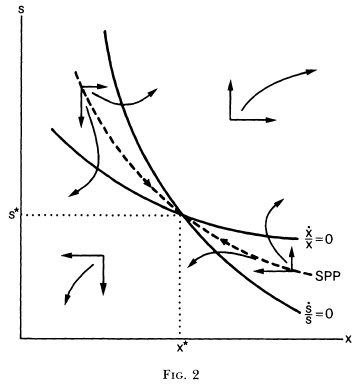
The author does not provide empirical evidence but builds a model of human-vampire dynamics. One derived theorem, illustrated in Figure 2, is the Vampire Neutrality Theorem:

Although human beings have endured the recurring ravages of vampires for centuries, scarcely any attempts have been made to analyze the macroeconomic implications of this problem and to devise socially optimal policy responses. Despite the increasing incidence of vampire epidemics in recent years (in Transylvania, Hollywood, and elsewhere), vampirism remains a thoroughly neglected topic in the theory of macroeconomic policy. The "vampires" considered in this paper are not the blood-sucking bats (e.g., Desmodus rotundus or Diphylla ecaudata) to be found in the forests of tropical America, but the blood-sucking ghosts of dead Homo sapiens. The bats are comparatively innocuous; aside from taking their occasional blood sample from missionaries asleep in the jungle, they have had no measurable influence on human welfare. The blood-sucking ghosts, on the other hand, have periodically provided grave threats to human populations; their most conspicuous macroeconomic impact arises from their detrimental effect on the labor force.
The author does not provide empirical evidence but builds a model of human-vampire dynamics. One derived theorem, illustrated in Figure 2, is the Vampire Neutrality Theorem:
The spontaneous generation of vampires (i.e., the appearance of vampires ex nihilo) affects the optimal x and s in the short run but not in the long run. In other words, vampires are neutral in the long run.
Jun 4, 2011
Japan's Phillips Curve looks like Japan
Gregor W. Smith's (2008) article in the Journal of Money, Credit and Banking:

ht: Yoram Baumam, the world's only [private sector] stand-up economist, who lists funny economic articles on this page.
During the past 15 years Japan has experienced unprecedented, high unemployment rates and low (often negative) inflation rates. Japan's Phillips Curve is shown in the right-hand panel of Figure 1… Someone once said that a country's institutions and history are reflected in its Phillips Curve. For ease of viewing, the left-hand panel of Figure 1 rotates the Phillips Curve around the vertical axis... Clearly visible are the islands of Hokkaido and Honshu, though it is somewhat difficult to separately distinguish the southern islands of Kyushu and Shikoku. The Noto-Hanto Penninsula is evident to the north of the southern end of the main island of Honshu. Tokyo Bay is also visible... This research shows that the outcomes of the past 15 years were predictable as part of a stable, readily recognized Phillips curve. Further research work on Phillips curves and the new macroeconomic geography will focus on Chile.

ht: Yoram Baumam, the world's only [private sector] stand-up economist, who lists funny economic articles on this page.
Jun 1, 2011
How to evade capital controls in Iceland?
You just have to buy a Rolex and sell it abroad at a discount. Gylfason explains on VoxEU:
Under extreme duress after the crash, Iceland also became the first industrial country in more than 30 years to call on the IMF for help... in a 180 degree turn from its handling of the East Asian crisis of 1997-1998, the IMF allowed Iceland to impose strict controls on capital movements, inward as well as outward... The controls were originally envisaged to be in effect for 2-3 years... The reality has turned out differently. The Icelandic authorities have recently sought authority to keep the controls in place until 2015. The Rolex index – the number of high-end watches sold per person – is high in Iceland not necessarily because the economy’s top echelon is doing so well but rather because ordinary people have no access to foreign exchange beyond their monthly allotment of €2,150 for foreign travel plus their modest credit card limits, so they are rumoured to buy expensive watches at home for resale at a discount abroad. Welcome back to the 1950s.
Subscribe to:
Posts (Atom)


